Case method
Profitability Case Interview: The Framework, a Full Example and the Traps to Avoid
Profits are falling and the client wants to know why. It is the most common case type in consulting interviews. Here is how to structure it, find the root cause quickly and close with a recommendation.
Editorial team · 21 October 2026 · 8 min read
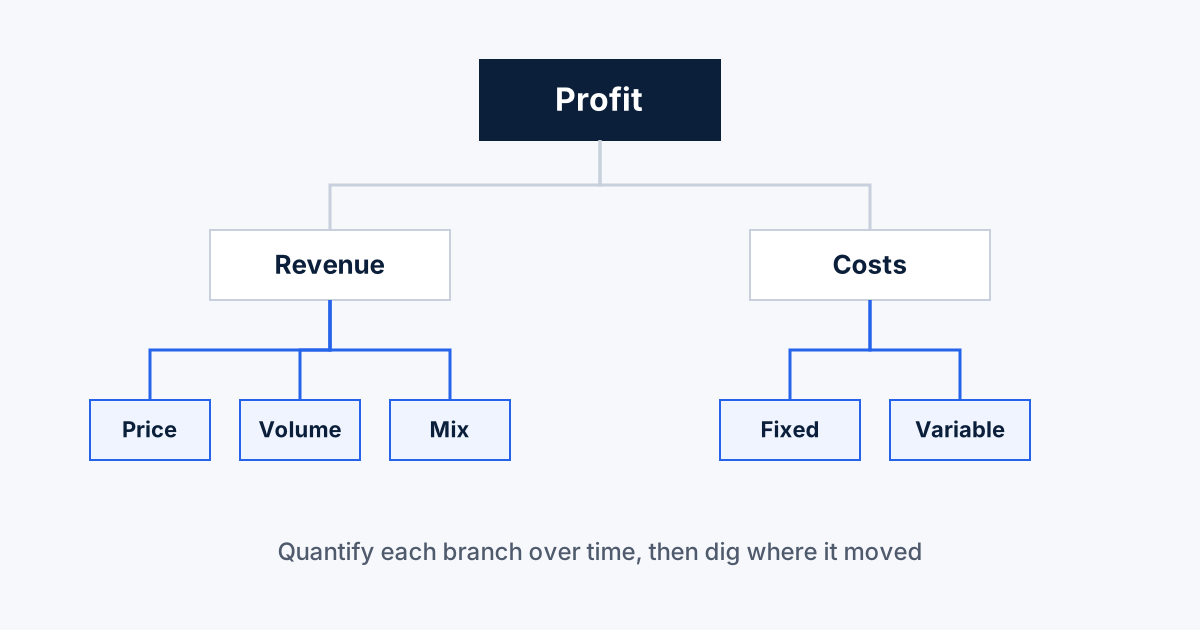
'Our client's revenue is growing, but profit is falling. What is going on?' If you interview with McKinsey, BCG or Bain, you will almost certainly meet a version of this question. Profitability cases are popular because they test everything at once: structure, maths, reading exhibits and business sense.
The profit tree
Profit equals revenue minus costs. Revenue splits into price times volume, and often by product, channel or customer segment (the mix). Costs split into fixed costs (rent, salaries, IT) and variable costs (raw materials, packaging, commissions). That is the backbone. What makes it a good answer is adapting it to the client: a bakery chain, an airline and a software company do not lose money for the same reasons.
| Branch | Questions to ask | Typical root causes |
|---|---|---|
| Price | Did our prices move? Did competitors'? | Discounting, price war, no inflation pass-through |
| Volume | Are we selling more or fewer units? Is the market growing? | Lost share, shrinking market, capacity limits |
| Mix | Which products, channels or customers grew? | Growth in low-margin products or channels |
| Variable costs | Did cost per unit rise? | Input inflation, supplier change, commissions |
| Fixed costs | Did we add stores, staff, systems? | Expansion ahead of demand, one-off costs |
A method in four moves
- Clarify the objective and the time frame: how much has profit fallen, since when, and what does the client want (back to last year's margin, or a target)?
- State a hypothesis early: 'Since revenue is growing, I suspect costs or mix, not volume.'
- Quantify before you explain: ask for the numbers over two or three years and compute changes and ratios.
- Dig where it moved, then recommend: name the root cause, size the fix, give the risks and next steps.
Worked example: a bakery chain
A regional bakery chain grew revenue from 50 to 54 million euros in a year, yet profit fell from 6 to 4.3 million. The candidate asks for the cost breakdown and gets this table (in millions of euros).
| Last year | This year | Change | |
|---|---|---|---|
| Revenue | 50.0 | 54.0 | +4.0 |
| Ingredients | 15.0 | 17.3 | +2.3 |
| Staff | 18.0 | 19.2 | +1.2 |
| Rent | 7.0 | 7.2 | +0.2 |
| Other (delivery, packaging) | 4.0 | 6.0 | +2.0 |
| Profit | 6.0 | 4.3 | -1.7 |
Worked example
How a strong candidate reads it
- Margin fell from 12% (6/50) to about 8% (4.3/54).
- Ingredients went from 30% to 32% of revenue: input prices rose faster than our prices.
- Staff stayed at about 36% of revenue: not the problem.
- 'Other' jumped by 50%: the client asks, and learns that 5 million of new sales came from delivery apps charging a 30% commission, so 1.5 million of commissions.
- Root cause: growth came from a low-margin channel, and ingredient inflation was not passed on to prices.
The recommendation follows from the numbers: raise prices on the products where ingredients rose most, renegotiate or rebalance delivery (higher delivery prices, own click and collect), and track margin by channel every month. A good close sizes it: passing on half of the ingredient increase and cutting commissions by a third would recover about 1.6 million euros, most of the lost profit.
The traps interviewers watch for
- Listing every branch of the tree without ever choosing where to dig.
- Looking at absolute costs only: a cost that grows with revenue is not a problem, a cost that grows faster is.
- Forgetting the mix: a growing low-margin product or channel can sink profit while every line looks fine.
- Ending on the diagnosis without a fix, or on a fix without a number.
How to practise
Do one profitability case every two days, out loud, with a timer. After each one, write down the root cause in one sentence and the number that proved it. If you cannot, the structure was too generic. Mix in exhibit-heavy cases: reading a table for the one line that moved is half the battle.
Frequently asked questions
Should I always use the profit tree?
Use it as a backbone, then tailor it. Interviewers penalise generic frameworks recited without thought, not the profit equation itself.
How do I find the root cause fast?
Compare each line over time and as a share of revenue. The line that grows faster than revenue, or the segment whose margin falls, is where to dig.
What makes a strong recommendation?
Answer first, the root cause with its number, two or three actions sized in money, then the main risk and the next step.