Case method
Market Sizing in Case Interviews: A 5-Step Method That Works Every Time
Almost every consulting interview contains an estimation. Here is a repeatable method, two examples solved end to end, and the mistakes interviewers see most often.
Editorial team · 16 October 2026 · 7 min read
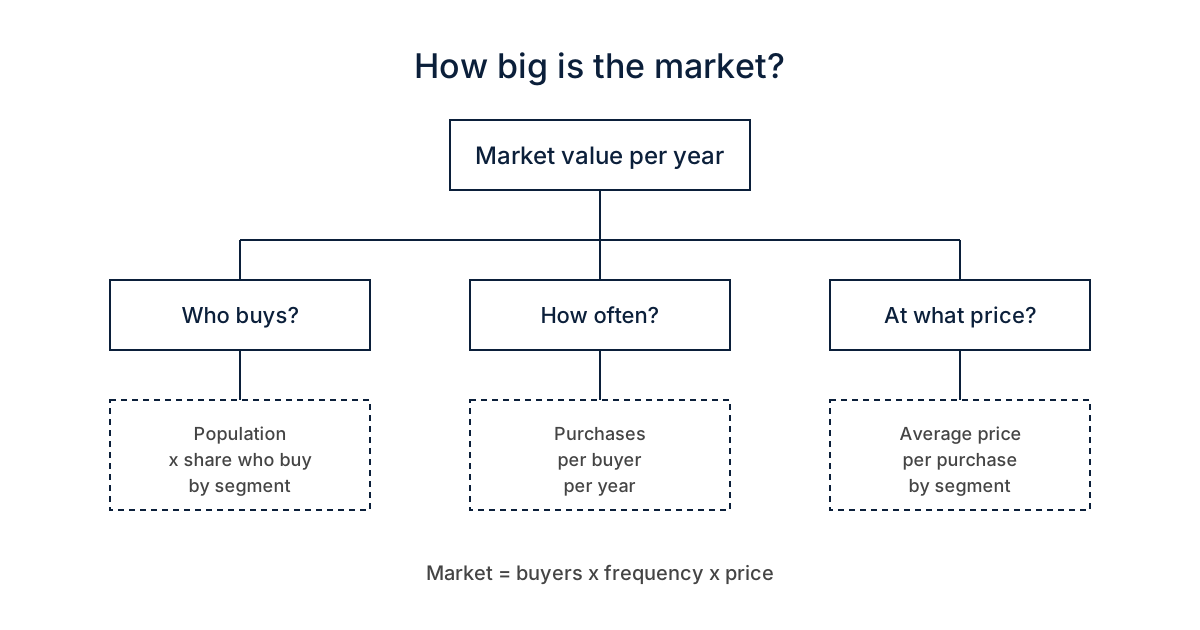
It is October, and first-round interviews at McKinsey, BCG and Bain are in full swing. Whatever the case, there is a good chance you will be asked to estimate something: the number of electric scooters in Paris, the revenue of a barbershop, the market for a new drug. Interviewers are not testing your general knowledge. They want to see whether you can break a fuzzy question into simple pieces, make sensible assumptions and stay calm with numbers.
Why interviewers ask market sizing questions
Market sizing shows up either as a standalone 'guesstimate' or, more often, inside a larger case: before deciding to enter a market, a client needs to know how big it is. Interviewers assess four things: structure (can you split the problem cleanly?), assumptions (are they realistic and explained?), maths (can you compute without a calculator?) and judgement (do you sanity-check the result and say what it means?).
The 5-step method
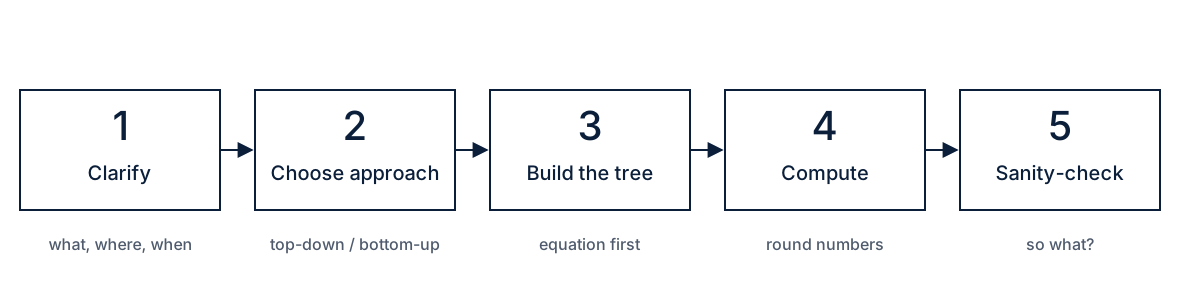
- Clarify the question: what exactly is measured (units or value?), where, and over what period (per year?).
- Choose the approach: top-down (start from a population and narrow down) or bottom-up (start from one point of sale and scale up).
- Build the tree: write the equation before any number, for example population x share who buy x frequency x price.
- Compute with round numbers: announce each assumption, round aggressively and keep track of zeros.
- Sanity-check and conclude: compare with something you know, then say what the number means for the client.
Top-down vs bottom-up: which one to choose?
| Top-down | Bottom-up | |
|---|---|---|
| Starts from | A population (people, households, companies) | A unit of supply (a store, a machine, a salesperson) |
| Best for | Consumer products and services | Supply-constrained or local markets |
| Typical equation | Population x % users x frequency x price | Number of outlets x capacity x utilisation x price |
| Main risk | Unrealistic adoption rates | Wrong capacity or utilisation assumptions |
When you have time, use one approach and check it with the other. If both land within the same order of magnitude, you can be confident.
Worked example 1: the men's haircut market in a university town
Question: How much do adult men in a town of 90,000 adults spend on haircuts each year?
- Clarify: adult men only, money spent per year, in town only.
- Approach: top-down from the population.
- Tree: men x share in each price segment x haircuts per year x price.
- Assumptions: 50% men, so 45,000; two-thirds go to cheap shops ($22), one-third to premium shops ($55); 10 haircuts a year.
- Compute: 30,000 x 10 x $22 = $6.6M, plus 15,000 x 10 x $55 = $8.25M, about $14.9M a year.
- Sanity check: about $330 per man per year, roughly $30 a month: plausible.
Worked example 2: how many coffees does a city-centre café sell per day?
Question: Estimate the daily coffee sales of one busy city-centre café.
- Approach: bottom-up from capacity, because a café is limited by its counter.
- Tree: opening hours x customers per hour at each time of day x coffees per customer.
- Assumptions: open 12 hours; 2 peak hours at 60 customers/hour, 4 medium hours at 30, 6 quiet hours at 10; 1.1 coffees per customer.
- Compute: (120 + 120 + 60) x 1.1 = 330 coffees a day.
- Sanity check: one barista can serve about one customer a minute, so 60 an hour at peak is the limit with one till: consistent.
The 6 mistakes interviewers see most
- Starting to multiply before stating the equation.
- Forgetting to segment (children vs adults, urban vs rural, cheap vs premium).
- Using precise but unjustified numbers ("68.4% of people...").
- Losing a zero: always write the unit next to each number.
- Never checking the result against something real.
- Stopping at the number without the 'so what' for the client.
Numbers worth knowing by heart
You will be faster and more credible with a few anchors: the population of your country and its main cities, the number of households, average household size, GDP, and a few prices (a coffee, a cinema ticket, a car). Our free order-of-magnitude quiz lets you drill these with a slider: you place your estimate and see instantly how far off you are.
How to practise market sizing
- Do one estimation a day, timed at 5 minutes, out loud.
- Alternate top-down and bottom-up questions.
- Write your tree on paper before any number, exactly as you would in the interview.
- Review: was the structure clean, the maths right, and the conclusion useful?
Frequently asked questions
How accurate does my market sizing need to be?
Interviewers rarely have an exact answer in mind. Being within 20 to 30% with a clear, logical structure is enough. Being exact with an opaque method is not.
Can I ask the interviewer for data during a market sizing question?
Yes. Ask whether they have data before assuming. If they say no, state your assumption, explain it in one sentence and move on.
How long should a market sizing take?
Inside a case, aim for 3 to 5 minutes. As a standalone question, 5 to 8 minutes including the sanity check.
Should I use top-down or bottom-up?
Use top-down for consumer markets defined by a population and bottom-up for markets limited by supply or capacity. Use the second one as a check if you have time.