Case method
McKinsey vs BCG vs Bain: How Their Case Interviews Really Differ
The three firms test the same skills, but not in the same way. Knowing who leads the case, and what each firm listens for, changes how you should practise.
Editorial team · 23 October 2026 · 7 min read
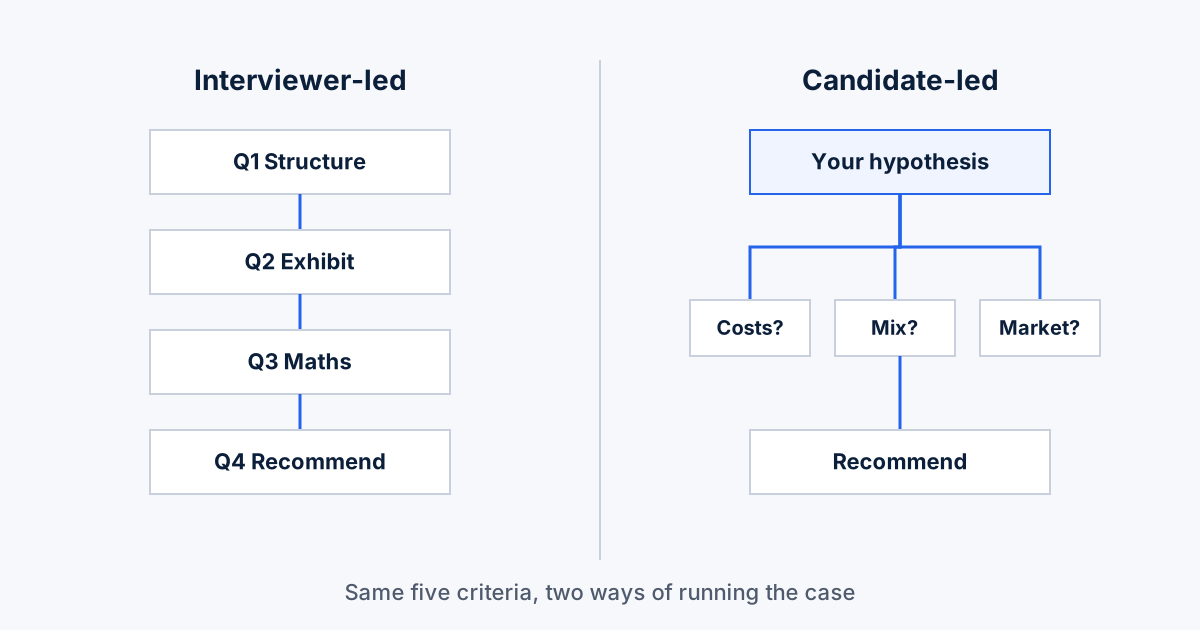
McKinsey, BCG and Bain all hire through case interviews, and all three look for the same things: clear structure, comfort with numbers, business judgement and a crisp recommendation. The difference is in the format. Practise only one format and the other can throw you off in the room.
Interviewer-led vs candidate-led
| Interviewer-led (typical at McKinsey) | Candidate-led (typical at BCG and Bain) | |
|---|---|---|
| Who drives | The interviewer asks each question in turn | You choose the next area to analyse |
| What it tests | Depth on each question, speed, precision | Prioritisation, hypothesis, autonomy |
| Data | Exhibits handed out at set moments | You must ask for the data you need |
| Common mistake | Answering only the question, without the 'so what' | Getting lost in the framework without a hypothesis |
In an interviewer-led case, the questions are fixed: structure the problem, read this exhibit, compute this number, brainstorm, recommend. The risk is to answer each question in isolation. Strong candidates link every answer back to the client's question. In a candidate-led case, the opening is the same, but then you steer: 'I would like to start with costs, because revenue is growing. Do we have the cost breakdown?' The risk is to wander. Strong candidates state a hypothesis and test it.
What each firm listens for
- McKinsey: structured, MECE thinking on each question, and the personal experience interview, which goes deep on one story about leadership, impact or conflict. Many candidates also take the Solve online assessment before the interviews.
- BCG: creativity and business sense in candidate-led cases, often with a strong brainstorming part. Some offices add an online case assessment before the interviews.
- Bain: a clear, answer-first style, practical recommendations, and a fit interview where culture and teamwork weigh a lot.
These are tendencies, not rules. Formats vary by office and by interviewer, and a BCG partner can run a very guided case. Prepare both formats whatever firm you apply to.
How to adapt your preparation
- Play each case twice: once interviewer-led, once candidate-led. You will feel the difference quickly.
- In candidate-led cases, say your hypothesis out loud after the framework, then ask for one precise piece of data.
- In interviewer-led cases, end every answer with one sentence on what it means for the client.
- Prepare three or four fit stories that each work for leadership, impact and conflict questions.
- Finish every case with the same close: answer first, three reasons with numbers, the main risk, the next step.
What is the same everywhere
Behind the formats, the scoring is remarkably similar. Interviewers at all three firms judge structure, quantitative analysis, reading of exhibits, business sense and synthesis. That is why CaseToHire scores every case on those five criteria, out of 20, whatever the format.
Frequently asked questions
Is McKinsey always interviewer-led?
Usually, but not always. Some interviewers let you drive part of the case. Prepare to do both.
Are BCG and Bain cases easier because I lead?
No. Leading means you must prioritise without being told where to look, which many candidates find harder.
Should I use a different framework for each firm?
No. Build a framework for the client's problem, not for the firm. Adapt how you drive the case, not how you think.